
- Andhra Pradesh is integrating its logistics system with ULIP. This will give real-time data for freight flows and air cargo across ports, airports, and industrial areas.
- The initiative will reduce delays, improve cold-chain management, and make the state’s airports more attractive to exporters and logistics companies.
- The project supports India’s national logistics goals and aligns with global supply chain standards.
India’s logistics sector is undergoing a structural shift, and the latest signal comes not from a major metro but from the eastern seaboard. Andhra Pradesh’s decision to integrate its logistics ecosystem with the Unified Logistics Interface Platform (ULIP) marks a pivotal step toward data-driven, interoperable freight systems—an evolution with direct implications for the country’s air cargo sector.
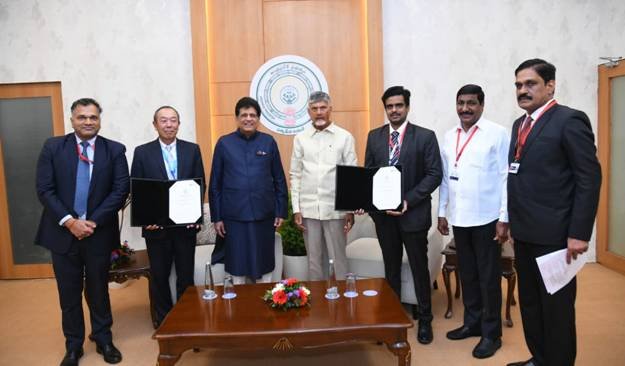
The Memorandum of Understanding (MoU) signed between the Government of Andhra Pradesh and NLDSL (NICDC Logistics Data Services Ltd) is more than a state-level digital initiative. It represents a policy moment in which logistics efficiency, air cargo competitiveness, and multimodal planning are increasingly anchored in digital governance. Announced in the presence of Union Minister of Commerce and Industry Shri Piyush Goyal and Chief Minister of Andhra Pradesh N. Chandrababu Naidu, the agreement signals the state’s intent to build an integrated data layer spanning ports, airports, industrial corridors, and warehousing clusters, embedding ULIP at the core of real-time logistics management.
Digital architecture for modern cargo networks
ULIP is India’s most comprehensive logistics data exchange, integrating 44 systems across 11 ministries through 136 APIs and providing access to over 2,000 real-time data fields. More than 210 industry applications have already been built on the platform, generating over 200 crore API transactions to date.
The MoU enables Andhra Pradesh to develop a centralised logistics dashboard powered by ULIP, allowing the state to monitor freight flows, multimodal utilisation, air cargo performance, and key performance indicators across government departments. For an economy that relies heavily on export-oriented manufacturing and temperature-sensitive cargo, such digital synchronisation offers tangible benefits.
Airports at Visakhapatnam, Vijayawada, and Tirupati stand to gain immediately. Each handles distinct cargo segments—pharmaceuticals, seafood, automotive, and agri-freight—that require close coordination between customs, cold-chain operators, port gateways, and ground handlers. Real-time visibility across these nodes can reduce dwell times, ease truck congestion outside cargo terminals, and improve predictability for exporters working with narrow time windows for perishables and APIs.
Optimising Andhra Pradesh’s export corridor
Andhra Pradesh occupies a unique position in India’s export landscape. The state is a major source of marine exports, pharmaceutical active ingredients, aerospace components, automotive systems, electronics assembly, and high-value perishables. Many of these rely heavily on airfreight.
Visakhapatnam Airport, for example, has seen rising volumes in pharma, engineering, and seafood consignments. ULIP-enabled transparency across vehicle movement, customs status, terminal handling, and multimodal handoffs can help mitigate bottlenecks that limit throughput and affect time-sensitive shipments.
Cold-chain visibility is another structural concern. Andhra Pradesh accounts for a significant share of India’s shrimp exports, making temperature integrity from farm gate to aircraft essential. Integrating ULIP with port-side and airport-side reefer monitoring systems could strengthen export reliability—a feature increasingly scrutinised by overseas regulators and buyers.
Anchoring national policy ambitions
The MoU aligns with India’s broader logistics reforms under the National Logistics Policy (NLP) and PM Gati Shakti. NLP aims to reduce logistics costs, currently estimated at 13–14% of GDP, to levels closer to OECD benchmarks, while Gati Shakti connects infrastructure projects through a unified geospatial network. ULIP serves as the digital spine linking these policy pillars.
For the Ministry of Civil Aviation, which projects India’s air cargo capacity to rise from 3.3 million tonnes to 10 million tonnes by 2030, the success of such digital corridors will determine whether physical capacity is matched by improvements in speed, transparency, and reliability. Without integrated data systems, expansions in airside infrastructure risk being undermined by inefficiencies in the first and last mile.
Implications for air cargo competitiveness
The digitisation initiative enhances the competitive position of Andhra Pradesh’s airports by embedding them in a transparent, interoperable freight ecosystem.
International benchmarks show that real-time visibility can reduce dwell times by 20–40%, depending on cargo mix and airport congestion. For shippers of pharmaceuticals, medical devices, and seafood, even a few hours’ reduction can determine market access, shelf-life, or compliance with overseas regulations.
ULIP’s integration with customs, port authorities, transport systems, and trade document repositories also enables seamless multimodal shifts between ports and airports. For exporters who alternate between sea and air depending on demand, runway access, and lead-time volatility, this flexibility carries clear commercial value.
Moreover, predictable digital workflows position the state as an attractive destination for global forwarders, integrators, and third-party logistics providers (3PLs), enhancing opportunities for regional consolidation, trans-shipment, and express cargo operations.
Physical to digital infrastructure
Although the MoU announcement did not include industry commentary, logistics stakeholders highlight the strategic importance of Andhra Pradesh’s decision.
The Government of Telangana noted that ULIP’s interoperability “is essential for building confidence among exporters and overseas buyers who increasingly expect real-time supply chain data, not periodic updates.”
It added that “this initiative will reduce friction for export-dependent sectors like perishables and pharma, where the cost of delay is disproportionately high.”
These observations underline an industry reality: digital capacity, not just airside capacity, increasingly defines competitiveness.
Regulatory and governance dimensions
The MoU also reinforces key principles in India’s logistics governance: data interoperability should be treated as a public good, API-based regulation can limit discretionary decision-making, and states must align with global standards set by ICAO, WCO, IATA, and other bodies.
Such alignment is critical as global supply chains evolve and compliance requirements tighten. With cross-border e-documentation, advanced cargo information systems, and electronic airway bills becoming mandatory in many markets, states with end-to-end digital capability will be better positioned to meet international expectations.
A blueprint for India’s next-generation air cargo network
The Andhra Pradesh–NLDSL partnership demonstrates what a modern air cargo ecosystem requires: real-time data, multimodal synchronisation, and predictive analytics layered over conventional infrastructure.
If implemented effectively, the initiative could reduce logistics costs, boost export competitiveness, and improve multimodal utilisation across ports and airports. It also provides a model for other states to replicate as India moves toward a unified digital logistics architecture.
In an era where trade increasingly rewards transparency and throughput, Andhra Pradesh’s adoption of ULIP is a substantive step toward aligning India’s air cargo sector with global best practices. It offers a preview of how states can move from fragmented logistics management to a coordinated, data-driven strategy that enhances both domestic efficiency and international credibility.

