
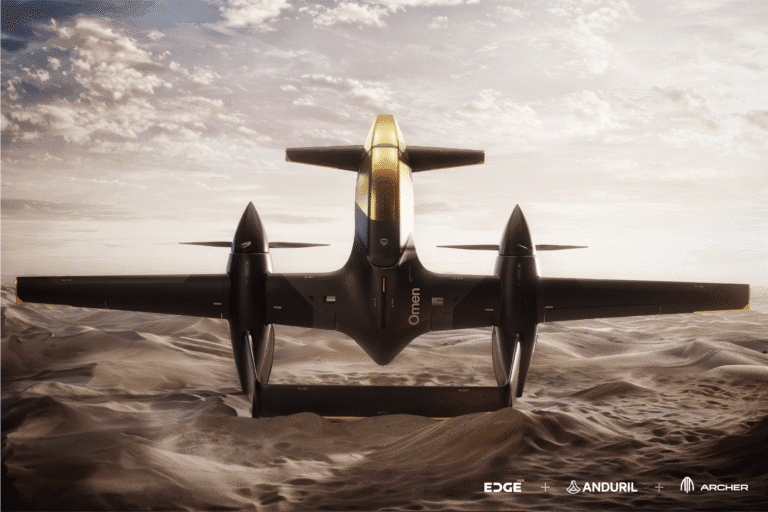
- Archer’s decision to supply its electric powertrain externally marks a significant shift in the commercial and defence applications of AAM technologies.
- The Anduril–EDGE partnership, supported by the UAE’s order of 50 Omen systems, signals strong regional demand for autonomous electric aviation.
- Archer’s proprietary propulsion platform strengthens its role as both an aircraft manufacturer and a strategic technology supplier.
The convergence of commercial electric aviation and defence innovation was highlighted at the Dubai Airshow 2025, where Archer Aviation announced a landmark agreement to supply its proprietary electric powertrain technology to Anduril Industries and the UAE’s EDGE Group.
This is the first time Archer has made its proprietary propulsion architecture available to external customers. The move reflects a broader shift in the advanced air mobility (AAM) sector, as governments and manufacturers reassess the strategic, regulatory, and commercial foundations of electric aviation.
The announcement has broader policy implications, illustrating how electric propulsion initially designed for urban air taxis is now being adapted for autonomous, dual-use aircraft programmes. This shift affects certification pathways, export controls, industrial scaling, and the alignment of sustainability objectives with defence capability requirements.
Omen programme
Archer confirmed that its powertrain will be used in Omen, a hover-to-cruise autonomous air vehicle—capable of vertical take-off and forward flight—jointly developed by Anduril and EDGE in the United Arab Emirates. The UAE has already committed to procuring 50 Omen systems, establishing early demand for both the platform and Archer’s propulsion hardware.
The commitment signals the country’s intent to accelerate sovereign capability in advanced air systems and position itself as a regional hub for next-generation aerospace production.
Dual-use applications
Archer has spent nearly a decade developing a vertically integrated electric propulsion system, originally designed for its Midnight eVTOL aircraft. Operating close to one million sq ft of manufacturing and testing facilities in the United States, the company produces battery packs and electric engines through automated processes that meet aviation-grade safety and reliability standards.
Archer’s founder and CEO, Adam Goldstein, described the Midnight aircraft as more than a vehicle. “We view Midnight as a platform that plays host to a wide range of aerospace technologies, leveraged far beyond our own aircraft. Our powertrain deal with Anduril is the first of what we expect to be many examples of this.”
Goldstein explained that the relationship between Archer and Anduril began with a hybrid-electric aircraft project and evolved as both teams recognised each other’s technical strengths. He characterised the new partnership as a move that opens a new revenue stream while reinforcing Archer’s strategy of leveraging core technologies across multiple aviation markets.
Implications for air mobility policy
For Anduril, whose model emphasises rapid iteration and deployment of autonomous systems, the agreement provides access to a mature propulsion architecture for a platform expected to operate in high-risk, high-tempo missions.
Shane Arnott, Anduril’s Senior Vice-President of Engineering, said the collaboration combined Archer’s propulsion expertise with Anduril’s autonomous systems experience. “By combining the Archer team’s powertrain technology with our engineering approach, we have matured our propulsion solution to achieve the ranges, speeds, and payload capacities required to make Omen operationally relevant,” he said.
EDGE Group’s participation situates the programme within the UAE’s broader industrial strategy. Since its launch in 2019, EDGE has consolidated more than 35 entities into advanced-technology clusters spanning platforms, weapons, cyber technologies, and homeland security. Its mandate includes accelerating the adoption of autonomous systems and fourth-industrial-revolution technologies, with a focus on export-oriented capability building.
Environmental, industrial and regulatory perspectives
Archer’s propulsion technology integrates aviation-grade batteries, electric engines, and energy-management systems designed for the rapid-turnaround flight profile of the Midnight eVTOL, which aims to reduce 60–90-minute car journeys to 10–20-minute electric flights. While Omen’s operational profile differs from that of a commercial air taxi, the propulsion characteristics—low noise, reduced thermal signature, optimised energy efficiency, and digital system monitoring—offer benefits for both civilian and defence missions.
Electric propulsion supports long-term decarbonisation goals. While defence programmes are not bound by commercial emissions frameworks, hybrid-electric and fully electric systems reduce fossil fuel dependence in specific missions and encourage innovation in zero-emission aerospace technologies.
Regulatory progress remains a key consideration. Archer’s Midnight aircraft continues its certification process with the US Federal Aviation Administration, while the UAE’s General Civil Aviation Authority has begun outlining rules for eVTOL operations and urban air mobility integration.
Programmes such as Omen, which combine autonomous capability with electric propulsion, sit at the intersection of unmanned aircraft regulation, defence export controls, and emerging AAM frameworks. Deployment will likely require coordination between civil aviation authorities, defence ministries, and standards-setting bodies.
Redefining market structure
The deal positions Archer not only as an aircraft manufacturer but also as a supplier of foundational electric propulsion systems for a broader set of aerospace applications. For air mobility manufacturers facing high capital requirements for certification, production, and infrastructure, revenue from technology components offers a more diversified and scalable commercial model.
The agreement also illustrates how industrial partnerships can accelerate sovereign capability and shorten deployment timelines for advanced air systems. For the wider air transport and policy community, it reflects the growing interaction between sustainability-focused commercial aviation innovations and the strategic priorities of defence ministries and national industrial programmes.
As electric propulsion moves from concept to operational deployment across multiple sectors, the Archer–Anduril–EDGE agreement may signal the future of air mobility ecosystems: interconnected, dual-use, and increasingly influenced by policy decisions linking sustainability, industrial strategy, and security considerations.

