
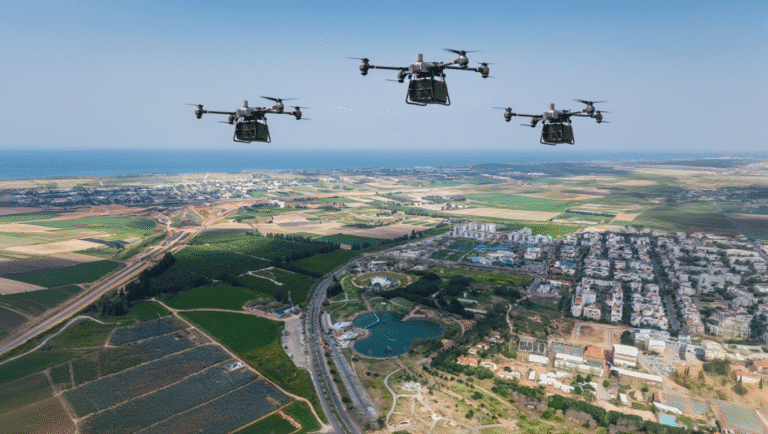
- Airwayz’s upgraded Dynamic UTM platform enables autonomous management of both manned and unmanned aircraft, providing complete situational awareness, reducing staff workload, and ensuring safer coexistence in increasingly congested cargo airspace.
- The system integrates strategic airspace reconfiguration and AI-driven conflict prediction, allowing priority cargo missions—such as pharmaceuticals and urgent spares—to be automatically identified and given protected air corridors in real time.
- By serving as a unified operational layer for all stakeholders, Dynamic UTM improves coordination between regulators, airport teams, and drone operators while generating data insights to optimise staffing, safety, and future airspace utilisation.
As air cargo becomes more reliant on drones, automated middle-mile logistics, and intelligent routing, a central question emerges: how can airports coordinate rising volumes of unmanned flights without overwhelming operations? According to Yair Yosef, co-founder and CPO and COO of Airwayz, the answer lies in autonomous, intelligent airspace management. “Air cargo is evolving fast,” he notes. “But without smarter coordination, the operational burden will increase sharply.”
Dynamic UTM (Unmanned Traffic Management) sits at the centre of this shift. The platform is designed to provide complete visibility and control in low-altitude airspace, where manned and unmanned aircraft increasingly share limited capacity. Airports and logistics zones have become highly dynamic environments. Traditional aviation movements continue to rise, while drone operations are accelerating even faster.
Yosef identifies three immediate challenges that the upgraded Dynamic UTM is engineered to solve. “There’s a lack of visibility of all unmanned activity in and around the airport perimeter,” he says. “There’s also difficulty managing growing drone operations without adding workload to controllers, and fragmented coordination between security, operations, and airspace teams.”
Rather than adding new layers of complexity, the upgraded platform is intended to streamline operations. “Our upgraded system provides clear situational awareness, reduces the cognitive burden on staff, and enables safer, smoother coexistence between all types of aerial activity,” Yosef explains. This is increasingly important at major cargo hubs, where drones already handle high-frequency movements such as urgent spares, pharmaceutical consignments, and e-commerce fulfilment loads.
Autonomous coordination of manned and unmanned aircraft
A standout capability of the Airwayz platform is its ability to manage the overlap between crewed and uncrewed flights. “We ensure safe coordination through a layered approach that combines both strategic and tactical capabilities,” Yosef says.
Strategically, the system relies on Advanced Dynamic Airspace Reconfiguration. “This ensures unmanned aircraft remain clear of manned aviation corridors, restricted zones, and approach or departure paths,” he explains. On the tactical level, an AI-driven prediction engine identifies potential conflicts early and suggests safe trajectories.
“We apply an AI-based prediction model that detects potential conflicts early and recommends safe trajectories before risks develop.”
This coordination is not only beneficial but increasingly required. With commercial airspace tightening and drone delivery networks expanding, the ability to accommodate diverse flight paths safely has become a regulatory priority.
Yosef points out that demand from cargo operations is strongly influencing the company’s roadmap. “We’re seeing strong demand from drone delivery, middle-mile logistics, and cargo automation programmes,” he says. That demand is steering development towards “scalability and automation – handling more missions with fewer human touchpoints; and mission-level coordination – ensuring that multiple fleets can operate safely in the same zone.”
Prioritisation in critical cargo scenarios
Cargo hubs also need reliable mechanisms for handling priority flights. “The system automatically identifies and prioritises critical flights,” Yosef explains. “The rules and policies about prioritisation are pre-configurated by the Airspace Authority.” Once a priority mission is detected, “it gets immediate access, protected air corridors, and nearby missions are adjusted in real time to keep the airspace safe.”
A shared operational picture
One long-standing challenge for airports is stakeholder fragmentation. Yosef argues that the new Dynamic UTM directly addresses this. “One of the core strengths of the new version is its ability to serve as a single operational layer for all stakeholders,” he says. “Airspace managers, airport security, drone operators, regulators, and even terminal teams can all work from the same picture and the same ruleset.”
Airports typically achieve independence within weeks. Success, Yosef says, is defined by “full visibility of all drone activity; reduced workload for airport staff; and safer, smoother operations with fewer manual interventions.”
Dynamic UTM also generates periodic insights into airspace usage. “This helps airports plan staffing and resources, improve safety planning, understand future demand, and identify opportunities for monetising drone operations,” he notes.

