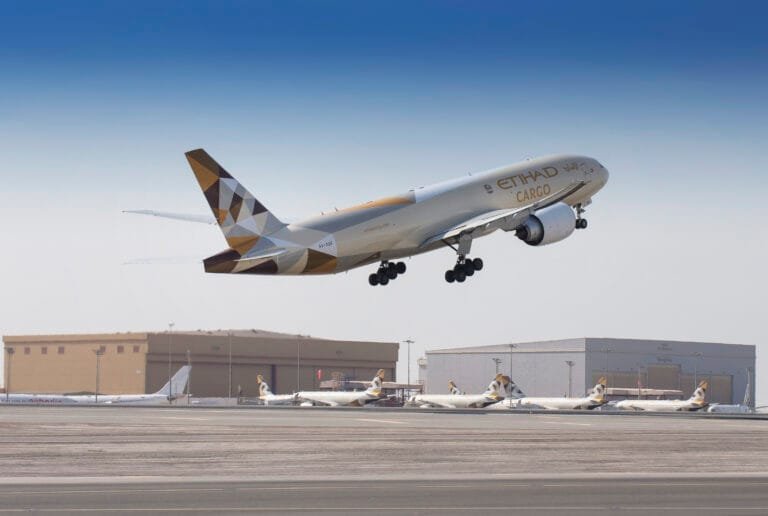
Etihad Airways has built a two-decade track record of strategic growth, focusing on customer-centric service, integrated passenger and cargo solutions, and disciplined fleet planning, including Boeing 777Fs and upcoming Airbus A350Fs to secure long-term capacity.
Abu Dhabi’s development as a logistics hub—with advanced airport infrastructure, free zones, and a parallel runway layout—supports Etihad Cargo’s operations, offering efficiency, expansion capacity, and a foundation for high-value segments like pharmaceuticals, perishables, and luxury goods.
Technology and specialization are central to future growth, including real-time shipment tracking (SmartTrack), AI-driven operational efficiency, and recruitment of industry experts, ensuring reliability, transparency, and continued leadership in Middle East and global air cargo markets.
Over the past two decades, the Middle East has transformed from a regional aviation hub into a global logistics powerhouse, driven by long-term strategic planning, massive infrastructure investments, and an unwavering focus on connectivity.
This rapid rise has not been without challenges. Global supply chain disruptions, volatile fuel prices, and shifting trade lanes have tested the resilience of carriers and airports alike. Yet, amid these complexities, one trend remains clear: airlines with a sharp strategic vision, customer-centric approach, and commitment to innovation are thriving.
“The supply chain, whether ocean, rail, truck or air, has been totally disturbed,” says Stanislas Brun, Chief Cargo Officer at Etihad Airways. “Those who can provide the right solution at the right price are the ones able to grow. And that’s where the opportunity lies.”
A journey of maturity
When Etihad launched operations in 2003, the airline entered a highly competitive market. Two decades on, it has carved out a unique identity rooted in quality and reliability. This transformation cannot be understood without recognising a fundamental principle: staying true to its own character.
“The idea was never to copy any other airline,” Stanislas explained. “We want to be ourselves. We have our own personality. At the end of the day, what is important is the customer.
“Even with a slight difference in price or longer flight times, customers will prefer to be well served.”
The pandemic tested this approach. Abu Dhabi’s strict health measures presented unique challenges, but they also accelerated strategic decisions. “Covid impacted everyone,” Stanislas stated.
“But it was the vision of the leadership and what was put in place that helped us deliver. Our success came from focusing on integrated solutions for both passenger and cargo, rather than operating in silos.”
The airline’s fleet strategy also reflects this disciplined approach. The decision to retire A330 freighters and invest in Boeing 777Fs, followed by the order of Airbus A350Fs, was not incidental.
“The A350’s characteristics—its weight, capacity and efficiency—made it the right choice,” Stanislas noted. “It allows us to maintain growth and prepare for the retirement of older aircraft over the next five years. With ten A350 freighters on order, we are securing capacity for the long term.”
Abu Dhabi: A strategic hub
Etihad’s rise cannot be separated from the evolution of Abu Dhabi as a logistics hub. The Emirate’s investments in airport infrastructure and free zone ecosystems have created an environment where airfreight thrives.
“Abu Dhabi now has a clear vision and direction,” said Stanislas. “It’s not just logistics; it’s tourism, entertainment, and economic diversification. All of that generates value for passenger and cargo growth.”
Recent projects illustrate this ambition—from the new state-of-the-art passenger terminal to enhanced cargo facilities slated for completion in 2027. The infrastructure includes a parallel runway layout and centralised terminal design, enabling simultaneous take-offs and landings. “This gives us a strong advantage,” Stanislas pointed out. “When other regional airports are congested, Abu Dhabi offers capacity and efficiency. Today, if you look at logistics in the Middle East, Abu Dhabi is the strongest asset any major logistics company can invest in.”
Etihad Cargo contributes significantly to this ecosystem, accounting for more than 80 percent of volumes at Abu Dhabi Airport. However, Stanislas is clear that the goal is not exclusivity. “We want more airlines to come and operate here,” he outlined. “That strengthens the hub and brings added value to the region.”
The next phase
Etihad’s long-term growth strategy goes beyond fleet renewal and network expansion. It is also about deepening specialisation in high-value segments such as pharmaceuticals, perishables and luxury goods.
The pandemic provided a springboard for this. “Pharma was a strong segment during Covid and remains so,” Stanislas recalls. “That period laid the foundation for our new pharma warehouse at the terminal, which will soon be upgraded as part of our infrastructure expansion.” Initiatives such as cool dollies for temperature-sensitive goods and participation in the Abu Dhabi Pharma Corridor highlight the airline’s role in building a trusted ecosystem for life sciences logistics.
Recruitment of industry specialists further supports this pivot. “We’ve strengthened our product team with experts from freight forwarding and other airlines,” Stanislas says. “This brings innovation and ensures we stay ahead in service delivery.”
Technology also plays a central role, with solutions like SmartTrack providing real-time shipment visibility. “From September, we are fully equipped with SmartTrack,” Stanislas confirms. “We want to commit to what we promise and prove our reliability. That transparency builds trust.”
Looking ahead, Etihad sees artificial intelligence as a key enabler of efficiency and customer value. “Abu Dhabi is investing heavily in AI—it even has a ministry dedicated to it,” Stanislas notes. “AI will help us streamline operations, automate low-value tasks and focus on creating real value for customers.”
As Etihad prepares to more than double its fleet within the next 10 years, its strategic intent is clear: to remain a global player anchored in the Middle East but connected to the world.
For Stanislas, the formula for success remains simple yet demanding. “We want to provide a premium experience for passengers and a reliable, high-quality service for cargo,” he says. “At the same time, we are generating value for Abu Dhabi and for our customers. That’s our vision for the future.”

